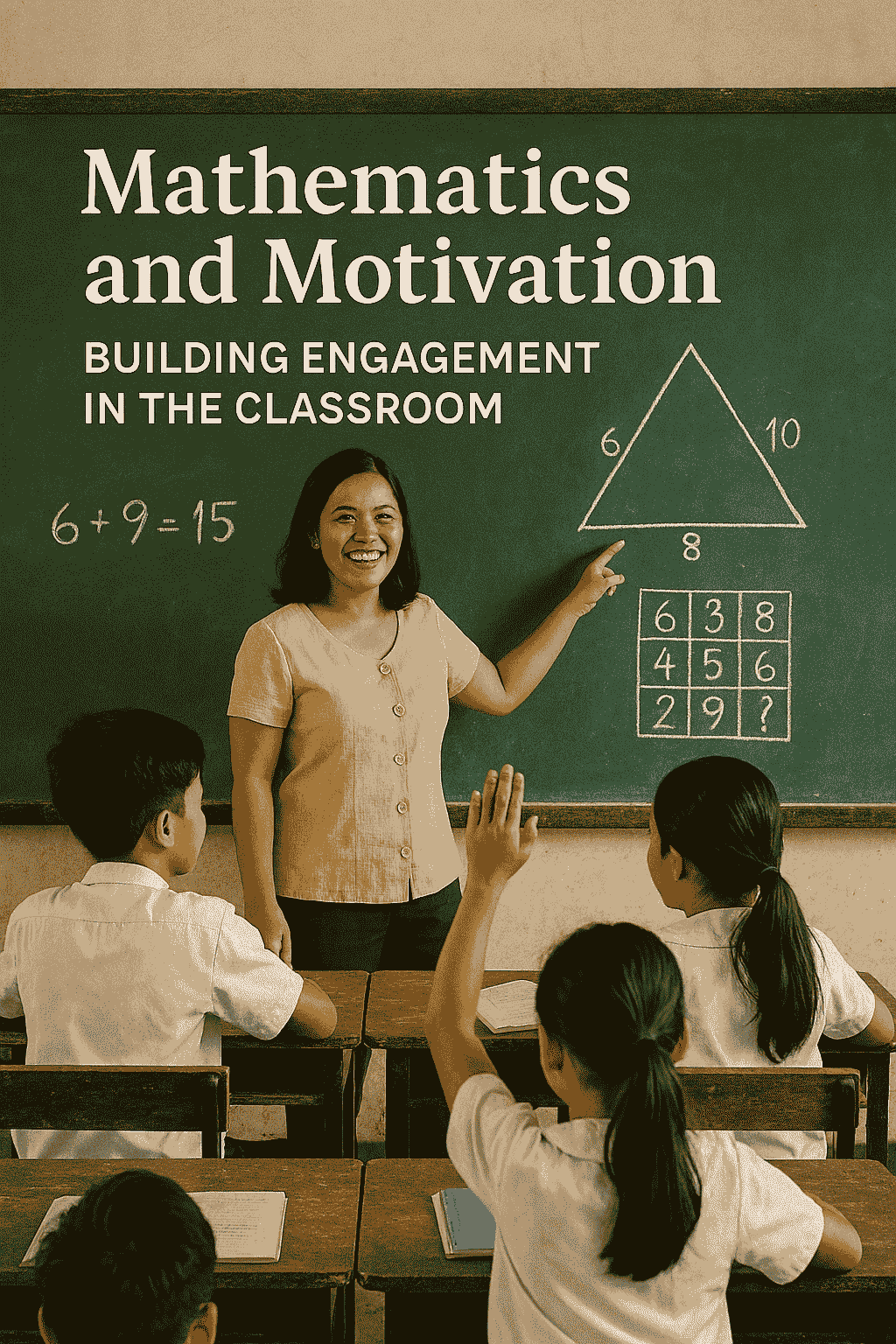
Mathematics and Motivation
Building Engagement in the Classroom
DOI:
https://doi.org/10.62596/eir.ek2bxr63Keywords:
motivation, engagement, mathematics educationAbstract
In an era of decreasing attention spans, sustaining motivation in mathematics classrooms poses significant challenges. Recent studies highlight the importance of adopting innovative teaching strategies that transform mathematics into an engaging and meaningful experience. Approaches such as enrichment activities, real-world applications, technological tools like virtual reality, and gamified learning have proven effective in fostering curiosity and participation. Moreover, cultivating a supportive environment that values resilience and constructive feedback nurtures a growth mindset among learners. Together, these methods promote sustained engagement, improved performance, and a deeper appreciation for mathematics.
References
Aker, M., Herrera, L. J. P., & Daniel, L. (2018). Back to the future: The implications of Service and Problem-Based Learning in the Language, Literacy, and Cultural acquisition of ESOL students in the 21st Century. The Reading Matrix, 18(2), 165–181. https://eric.ed.gov/?id=EJ1191354
Bal-Taştan, S., Davoudi, S. M. M., Masalimova, A. R., Bersanov, A. S., Kurbanov, R. A., Boiarchuk, A. V., & Pavlushin, A. A. (2018). The impacts of teacher’s efficacy and motivation on student’s academic achievement in science education among secondary and high school students. Eurasia Journal of Mathematics, Science and Technology Education, 14(6). https://doi.org/10.29333/ejmste/89579
Espartero, M. M., Caldaza, K. P. D., & Del Prado, R. T. (2024). Analyzing the level of interest of high school students in solving mathematical problems in the modular and face-to-face learning. Environment and Social Psychology, 9(4). https://doi.org/10.54517/esp.v9i4.2167
Ichsan, I., Suharyat, Y., Santosa, T. A., & Satria, E. (2023). Effectiveness of STEM-based learning in teaching 21st-century skills in Generation Z students in science learning: A meta-analysis. Jurnal Penelitian Pendidikan IPA, 9(1), 150–166. https://doi.org/10.29303/jppipa.v9i1.2517
Suherman, I., Fauziah, S. P., Roestamy, M., Bilad, M. R., Abduh, A., & Nandiyanto, A. B. D. (2023). How to improve student understanding in learning science by regulating strategy in language education? Definition, factors for enhancing students’ comprehension, and computational bibliometric review analysis. International Journal of Language Education, 7(3). https://doi.org/10.26858/ijole.v7i3.56014
Tlili, A., Huang, R., Shehata, B., Liu, D., Zhao, J., Metwally, A. H. S., Wang, H., Denden, M., Bozkurt, A., Lee, L., Beyoglu, D., Altinay, F., Sharma, R. C., Altinay, Z., Li, Z., Liu, J., Ahmad, F., Hu, Y., Salha, S., ... Burgos, D. (2022). Is Metaverse in education a blessing or a curse: A combined content and bibliometric analysis. Smart Learning Environments, 9(1). https://doi.org/10.1186/s40561-022-00205-x
Downloads
Published
Issue
Section
License
Copyright (c) 2025 EDUCATION AND INDUSTRY REVIEW

This work is licensed under a Creative Commons Attribution 4.0 International License.
How to Cite