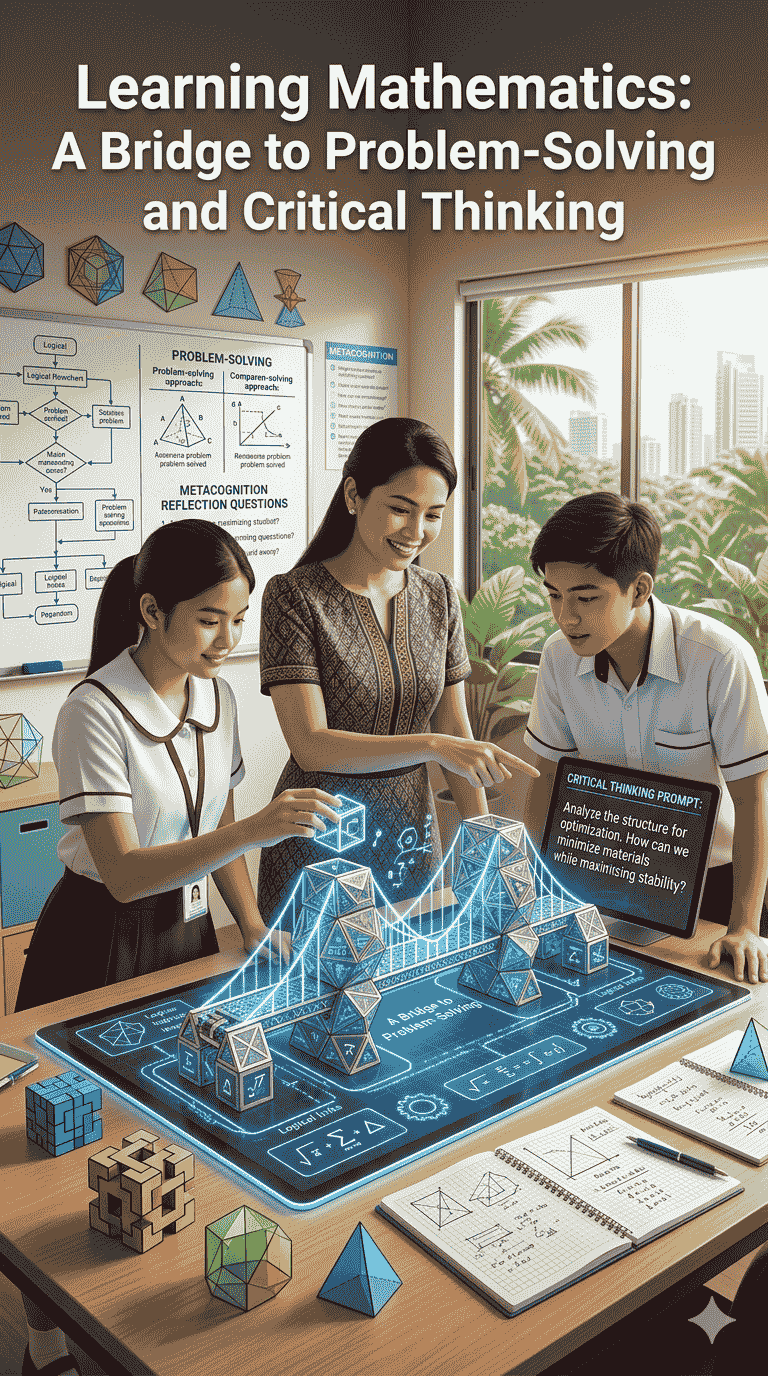
Learning Mathematics
A Bridge to Problem-Solving and Critical Thinking
DOI:
https://doi.org/10.62596/eir.mtcn7x20Keywords:
Problem-solving, Critical thinking, Mathematics educationAbstract
This paper emphasizes mathematics as a foundational discipline that extends beyond computation to the development of problem-solving and critical thinking skills. It highlights how structured reasoning, metacognition, and engagement with non-routine problems enable learners to analyze, evaluate, and construct logical solutions. Drawing on existing studies, the discussion shows that consistent exposure to problem-solving tasks in mathematics strengthens analytical thinking, fosters independence, and enhances students’ ability to apply knowledge in real-life situations. Ultimately, mathematics is presented as a transformative tool for intellectual development and decision-making.
References
Cahya, E., & Juandi, D. (2021). Students' critical thinking skills in solving mathematical problems: A systematic procedure of grounded theory study. International Journal of Instruction, 14(4), 529–548.
Harahap, V. F. (2023). The role of students' critical thinking ability in learning mathematics with problem solving. EDUCTUM: Journal Research, 2(5), 140–144.
Leader, L. F., & Middleton, J. A. (2004). Promoting critical-thinking dispositions by using problem solving in middle school mathematics. RMLE Online, 28(1), 1–13.
Schoenfeld, A. H. (2016). Learning to think mathematically: Problem solving, metacognition, and sense making in mathematics (Reprint). Journal of Education, 196(2), 1–38.
Voskoglou, M. G., & Buckley, S. (2012). Problem solving and computational thinking in a learning environment. arXiv preprint arXiv:1212.0750.
Downloads
Published
Issue
Section
License
Copyright (c) 2026 EDUCATION AND INDUSTRY REVIEW

This work is licensed under a Creative Commons Attribution 4.0 International License.
How to Cite