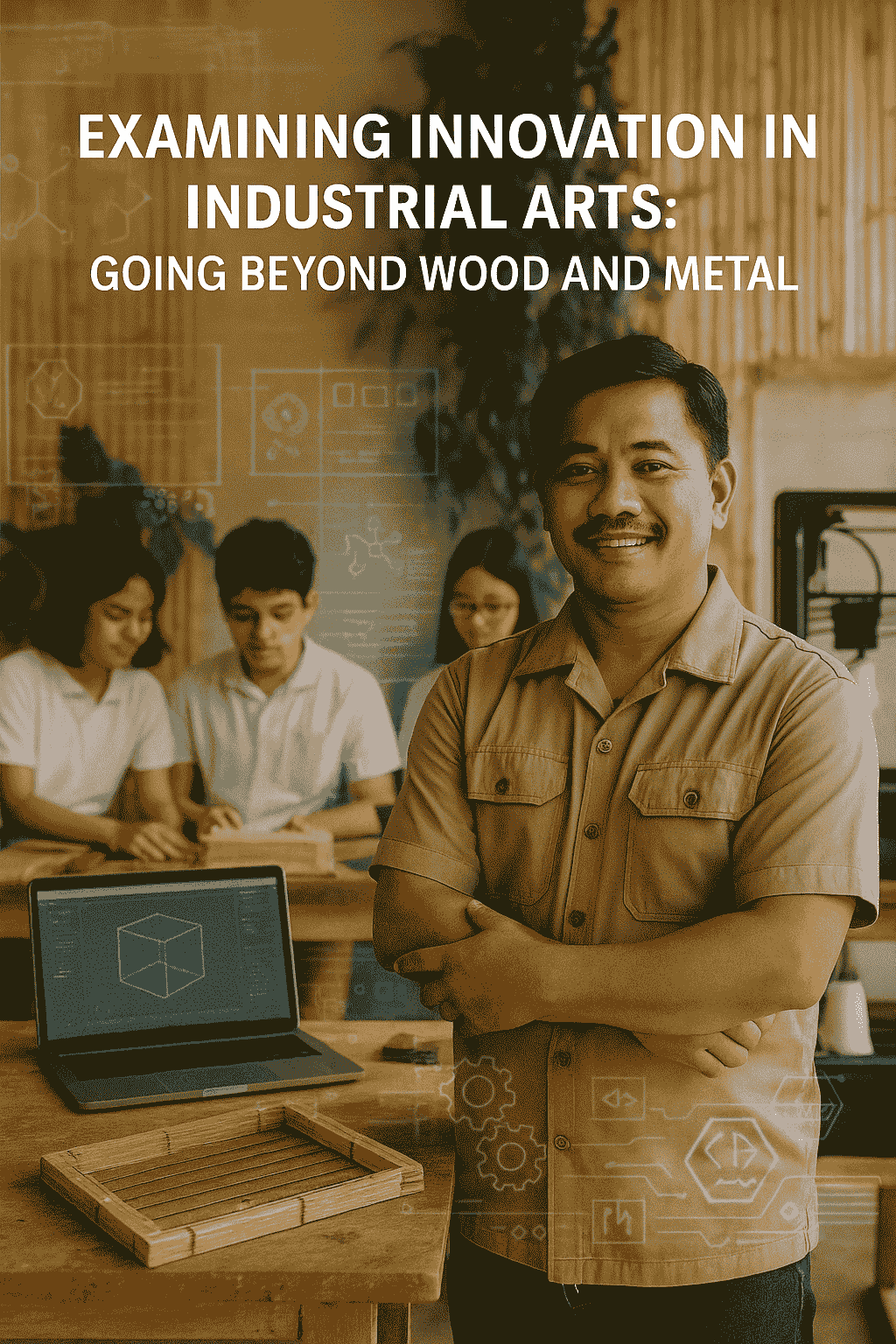
Examining Innovation in Industrial Arts
Going Beyond Wood and Metal
DOI:
https://doi.org/10.62596/eir.d5yh5606Keywords:
Industrial Arts, Digital Innovation, SustainabilityAbstract
This article explores the evolving role of Industrial Arts education in the Philippines, advocating a shift beyond traditional woodworking and metalwork. It highlights the integration of digital tools, sustainability practices, and design thinking to equip students with 21st-century skills necessary for innovation and environmental responsibility. Through case examples and emerging initiatives, the study emphasizes enriching conventional methods to prepare Filipino learners for a knowledge-based and sustainable economy.
References
Castro FLT, Ventura BLO, Estajal RS, et al. Teachers handling multiple subject areas: difficulties and adaptive attributes in the delivery of instructions. Environment and Social Psychology. 2024;9(9):2520. doi:10.59429/esp.v9i9.2520
Herfurth F, Söll M, Gerber SK, Diettrich A. Empowering students through design thinking: a strategic approach to developing 21st-century skills in higher education. 2025. doi:10.4995/HEAd25.2025.20103
Müller E, Ahmed A, Jane K. Materials sustainability: developing sustainable and environmentally friendly materials. 2024.
Nyemba WR. Computer aided design: engineering design and modeling using AutoCAD. 2022. doi:10.1201/9781003288626
Puddicombe C, Rouse R, Tolomei M, Ellis D. Students as designers with 3D design and fabrication technologies. 2025. doi:10.4324/9781003490715-11
Pyatkin M. Integrating design thinking and systems thinking for entrepreneurial innovation: a holistic approach. 2025. doi:10.5281/zenodo.14809127
Downloads
Published
Issue
Section
License
Copyright (c) 2025 EDUCATION AND INDUSTRY REVIEW

This work is licensed under a Creative Commons Attribution 4.0 International License.
How to Cite