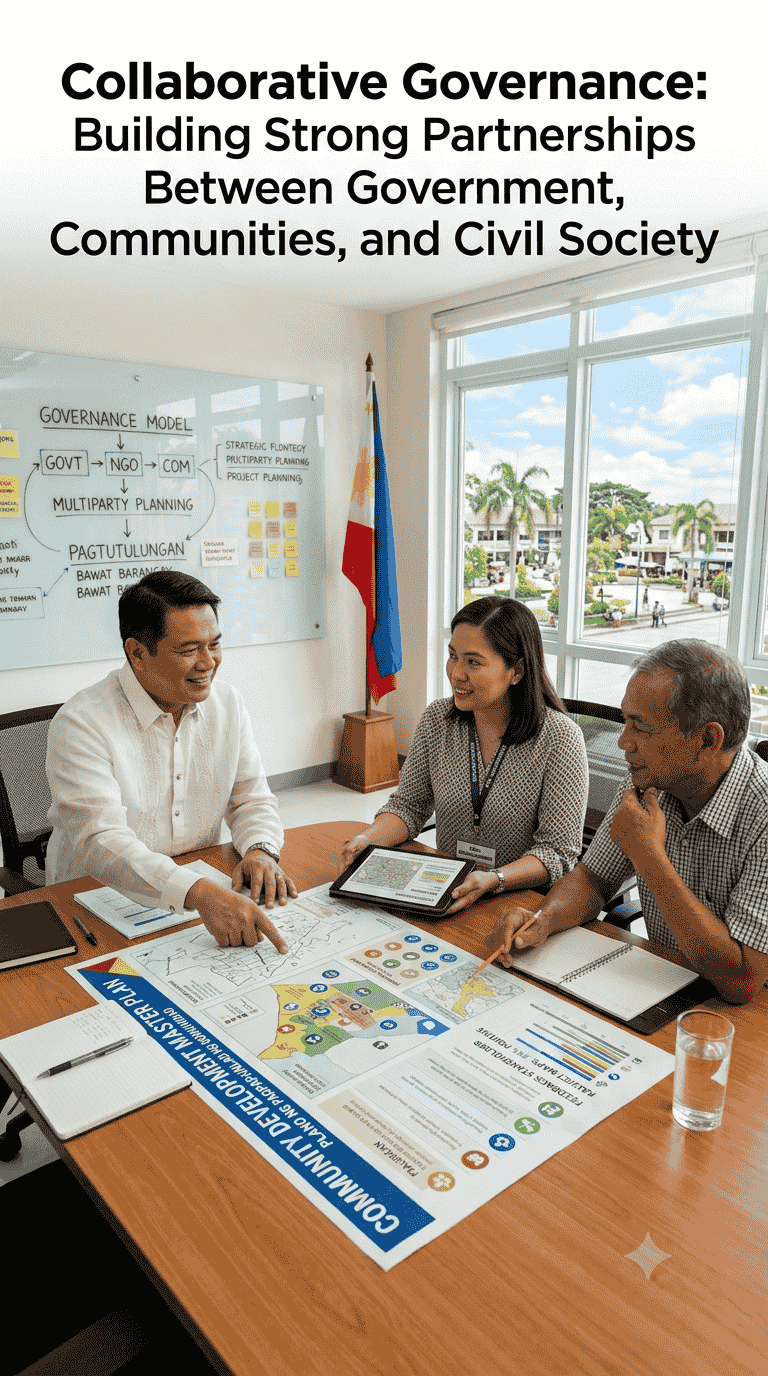
Collaborative Governance
Building Strong Partnerships Between Government, Communities, and Civil Society
DOI:
https://doi.org/10.62596/eir.cwncd324Keywords:
Collaborative Governance, Stakeholder Participation, Sustainable DevelopmentAbstract
Collaborative governance strengthens public administration by fostering partnerships among government, communities, civil society, and other stakeholders to address complex societal challenges through shared decision-making and accountability. By promoting inclusive participation, collaborative leadership, and digital engagement, it enhances public trust, service delivery, and policy innovation. Ultimately, collaborative governance supports sustainable development by building resilient institutions and empowering stakeholders to achieve common development goals.
References
Ansell, C., & Gash, A. (2008). Collaborative governance in theory and practice. Journal of Public Administration Research and Theory, 18(4), 543–571. https://doi.org/10.1093/jopart/mum032
Crosby, B. C., & Bryson, J. M. (2018). Why leadership of public leadership research matters: And what to do about it. Public Management Review, 20(9), 1265–1286. https://doi.org/10.1080/14719037.2017.1348731
Emerson, K., Nabatchi, T., & Balogh, S. (2012). An integrative framework for collaborative governance. Journal of Public Administration Research and Theory, 22(1), 1–29. https://doi.org/10.1093/jopart/mur011
Torfing, J., Sørensen, E., & Røiseland, A. (2019). Transforming the public sector into an arena for co-creation: Barriers, drivers, benefits, and ways forward. Administration & Society, 51(5), 795–825. https://doi.org/10.1177/0095399716680057
United Nations. (2015). Transforming our world: The 2030 Agenda for Sustainable Development. https://sdgs.un.org/2030agenda
Downloads
Published
Issue
Section
License
Copyright (c) 2026 EDUCATION AND INDUSTRY REVIEW

This work is licensed under a Creative Commons Attribution 4.0 International License.
How to Cite