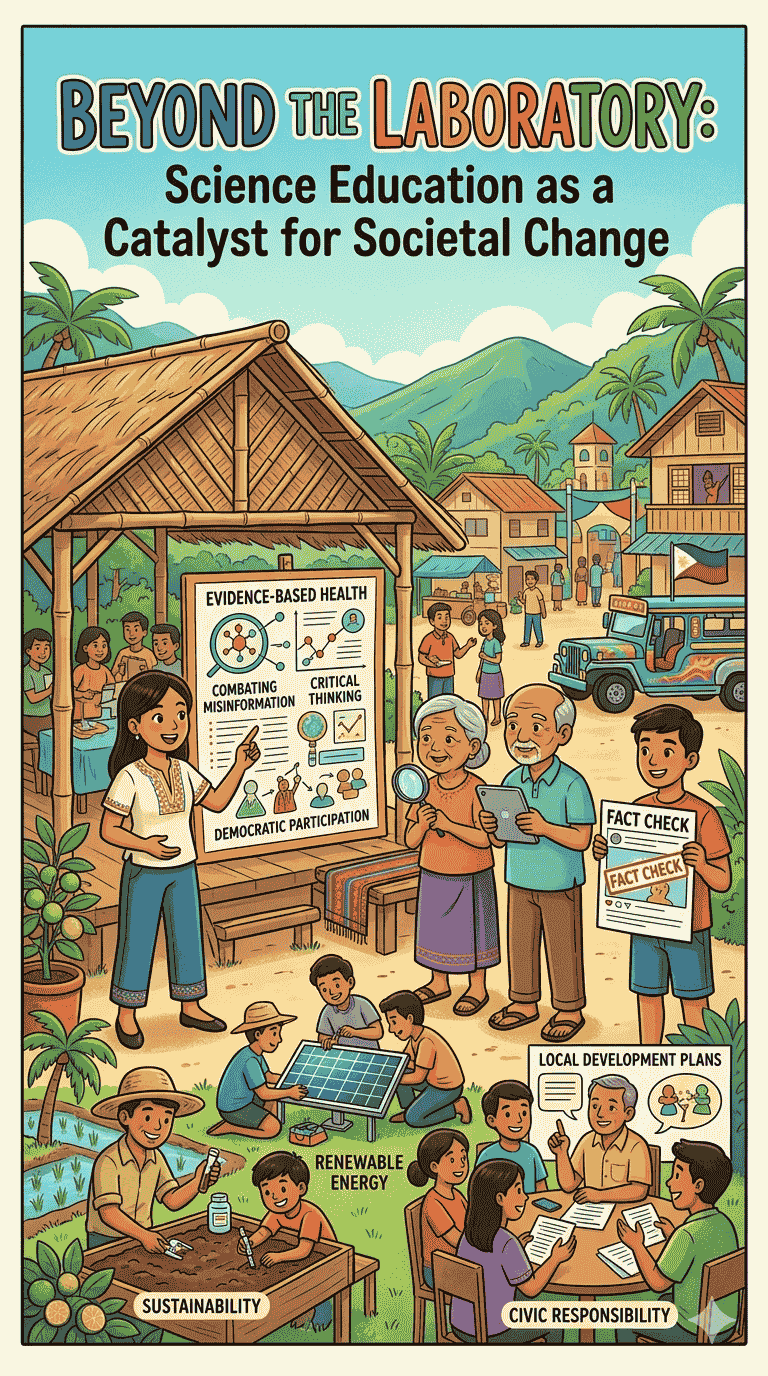
Beyond the Laboratory
Science Education as a Catalyst for Societal Change
DOI:
https://doi.org/10.62596/eir.10nsv513Keywords:
Scientific Literacy, Critical Thinking, Civic EngagementAbstract
Science education extends beyond factual learning by developing critical thinking, scientific literacy, and informed decision-making skills essential for active citizenship. It empowers learners to evaluate evidence, address socio-scientific issues, and resist misinformation in an increasingly digital society. Ultimately, science education serves as a catalyst for democratic participation, responsible action, and societal resilience.
References
Cavagnetto, A. R. (2010). Argument to foster scientific literacy: A review of argument interventions in K–12 science contexts. Review of Educational Research, 80(3), 336–371.
Chowdhury, T. B. M., Holbrook, J., & Rannikmäe, M. (2020). Addressing sustainable development: Promoting active informed citizenry through trans-contextual science education. Sustainability, 12(8), 3259.
Howell, E. L., & Brossard, D. (2021). (Mis) informed about what? What it means to be a science-literate citizen in a digital world. Proceedings of the National Academy of Sciences, 118(15), e1912436117.
National Academies of Sciences, Engineering, and Medicine. (2016). Science literacy: Concepts, contexts, and consequences. Washington, DC: National Academies Press.
Yacoubian, H. A. (2018). Scientific literacy for democratic decision-making. International Journal of Science Education, 40(3), 308–327.
Downloads
Published
Issue
Section
License
Copyright (c) 2026 EDUCATION AND INDUSTRY REVIEW

This work is licensed under a Creative Commons Attribution 4.0 International License.
How to Cite