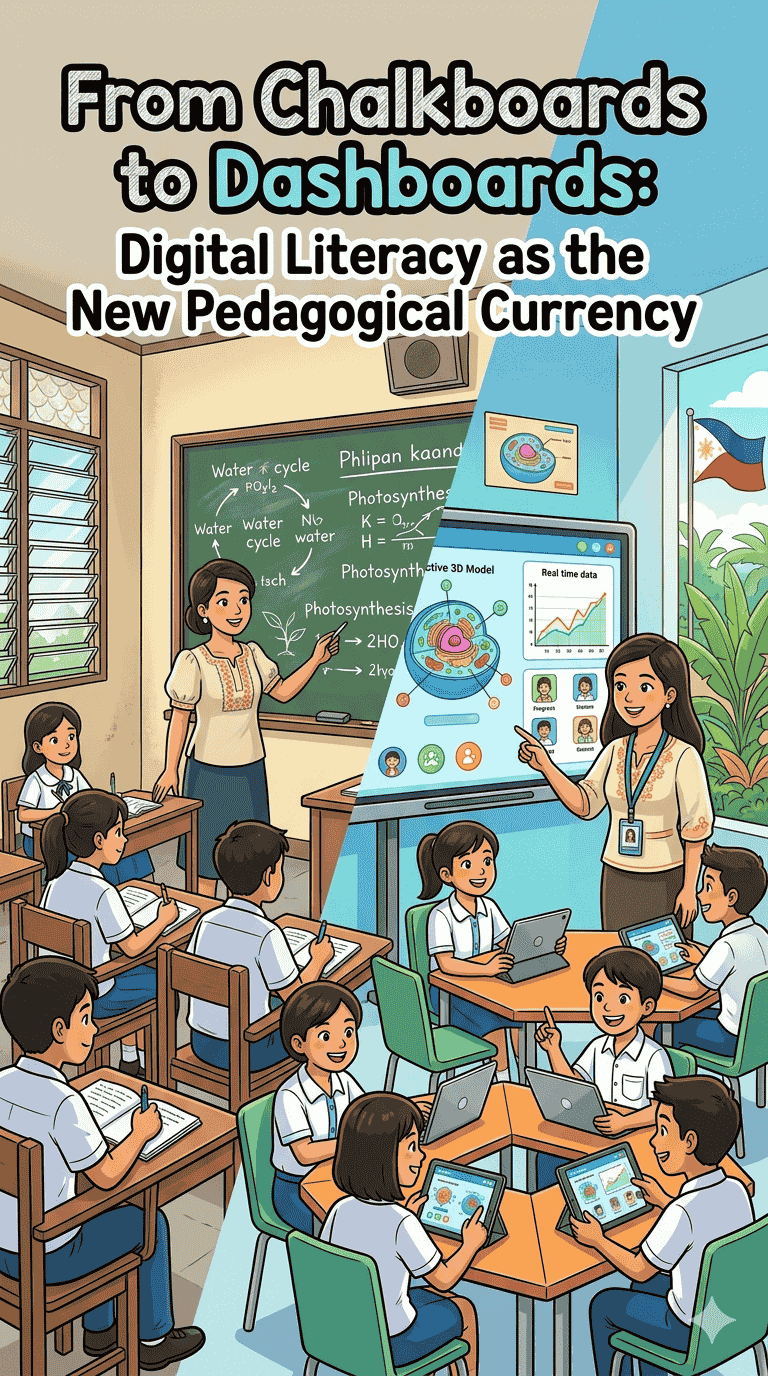
From Chalkboards to Dashboards
Digital Literacy as the New Pedagogical Currency
DOI:
https://doi.org/10.62596/eir.p3ce6211Keywords:
Digital Literacy, Science Education, Interactive LearningAbstract
This paper highlights the growing importance of digital literacy in transforming science education from traditional chalkboard instruction to interactive, technology-driven learning environments. Digital tools such as simulations and learning management systems enhance student engagement, conceptual understanding, and academic performance while supporting data-informed and student-centered teaching practices. The study emphasizes that digitally competent educators play a crucial role in creating adaptive and collaborative learning experiences for 21st-century learners.
References
Almasri, F. (2022). Simulations to teach science subjects: Connections among students’ engagement, self-confidence, satisfaction, and learning styles. Education and Information Technologies, 27(5).
Chamberlain, J. M., Lancaster, K., Parson, R., & Perkins, K. K. (2014). How guidance affects student engagement with an interactive simulation. Chemistry Education Research and Practice, 15(4), 628–638.
Fuentes, R. P., & LaBad, R. B. (2025). Impact of digital learning tools on student engagement and academic achievement in higher education.
Pagutayao, V. S., & Paglinawan, J. L. (2024). Digital learning tools availability and students’ engagement in science. International Journal of Research and Innovation in Applied Science, 9(12), 13–19.
Wahidin, W., Gutierrez, G., Osman, K., Akkapin, S., & Tan, M. L. T. (2025). Digital simulations in science learning: A student perspective on interactive engagement, conceptual understanding, and learning satisfaction.
Downloads
Published
Issue
Section
License
Copyright (c) 2026 EDUCATION AND INDUSTRY REVIEW

This work is licensed under a Creative Commons Attribution 4.0 International License.
How to Cite