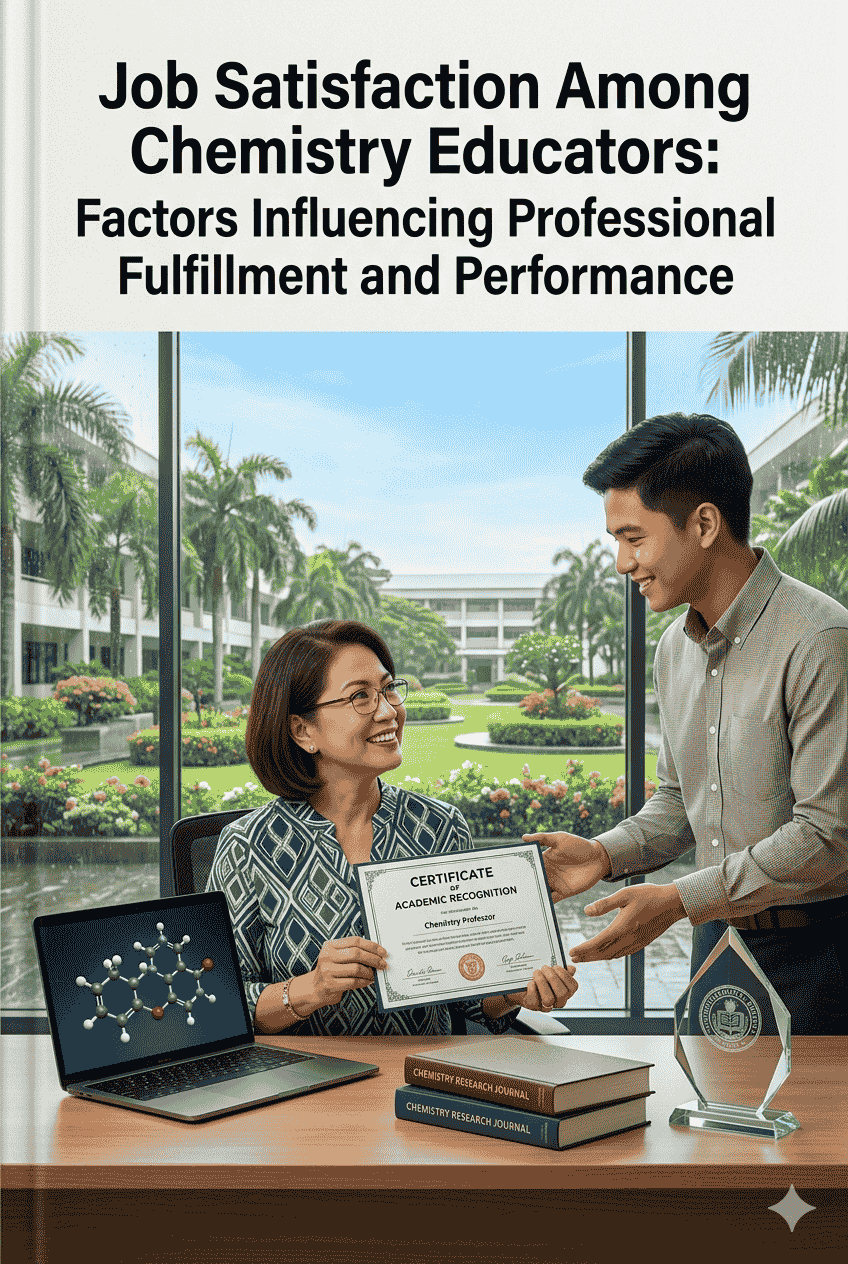
Job Satisfaction Among Chemistry Educators
Factors Influencing Professional Fulfillment and Performance
DOI:
https://doi.org/10.62596/eir.qxwckx87Keywords:
Job Satisfaction, Chemistry Educators, Professional FulfillmentAbstract
This study examines the factors influencing job satisfaction among chemistry educators and their impact on professional fulfillment and performance. Key determinants include professional development opportunities, supportive work environments, manageable workloads, fair compensation, positive workplace relationships, and recognition. Findings from existing literature indicate that higher job satisfaction enhances motivation, teaching effectiveness, commitment, and educational quality. The study emphasizes the importance of institutional support in fostering a productive and resilient chemistry education workforce.
References
Collie, R. J., Shapka, J. D., & Perry, N. E. (2012). School climate and social–emotional learning: Predicting teacher stress, job satisfaction, and teaching efficacy. Journal of Educational Psychology, 104(4), 1189–1204.
Herzberg, F. (1968). One more time: How do you motivate employees? Harvard Business Review, 46, 53–62.
Johnson, S. M., Kraft, M. A., & Papay, J. P. (2012). How context matters in high-need schools: The effects of teachers’ working conditions on their professional satisfaction and their students’ achievement. Teachers College Record, 114(10), 1–39.
Klassen, R. M., & Chiu, M. M. (2010). Effects on teachers' self-efficacy and job satisfaction: Teacher gender, years of experience, and job stress. Journal of Educational Psychology, 102(3), 741–756.
Skaalvik, E. M., & Skaalvik, S. (2017). Motivation and job satisfaction among teachers: The role of school goal structure and value consonance. Teaching and Teacher Education, 67, 152–160.
Toropova, A., Myrberg, E., & Johansson, S. (2021). Teacher job satisfaction: The importance of school working conditions and teacher characteristics. Educational Review, 73(1), 71–97.
Downloads
Published
Issue
Section
License
Copyright (c) 2026 EDUCATION AND INDUSTRY REVIEW

This work is licensed under a Creative Commons Attribution 4.0 International License.
How to Cite